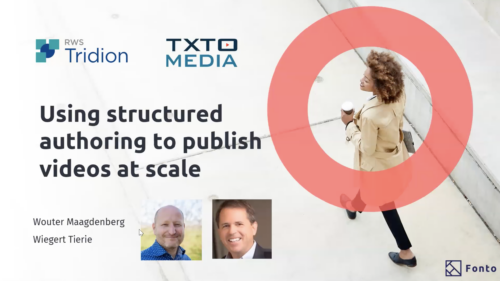

Component based content management, structured authoring, and semantics not only help us to scale and personalize documents and data driven publications, but also enable organizations to create, localize and maintain large volumes of rich media publications, such as e-learning courses, animations and for instance instruction videos. A growing number of use cases and business needs demand for video as the preferred format. Visual media, like video, often help people to understand, and remember topics and concept better. It helps to improve learning and reduce support cost. Also, adding video enables organizations to communicate with their stakeholders via channels and devices they prefer. The challenge is: how to make video scalable, compliant, and cost-effective?
During this talk Wiegert and Wouter not only explain how current technology supports organizations reaching these goals, but also how it positively influences operations, and competitive advantages of organizations.
Presented by Wiegert Tierie, RWS and Wouter Maagdenberg, TXTOmedia Wiegert Tierie is Vice President of Strategic Accounts and Tridion America Sales Team Lead. He brings over 25 years of experience in numerous senior leadership roles. He is an ambitious visionary executive that uniquely combines strategy, sales, and marketing experience with an extensive background in financial, business process optimization, and product management to offer our customers a competitive edge, building their brand and their go-to-market strategy. To deliver results and success for the key customers he works with. Earlier Wiegert worked with Tridion, the leading Dutch Customer Experience and WCM vendor, and successfully launched numerous projects with Marquee brands. Prior to that, he played a key role in the introduction of Adobe Acrobat in Europe. Wiegert earned a Master of Science in Business from the University of Groningen (The Netherlands). He loves the outdoors, sailing and currently lives near St. Petersburg FL (he moved from San Francisco, CA in May 2020)
 Wouter Maagdenberg is CEO and Cofounder of TXTOmedia. He is a serial entrepreneur who started his first tech company, during his BA studies at Erasmus University in 1996.
He sold his former company Calamares (Media Asset Management) to SDL (now RWS) in 2011. After leaving SDL, he started to develop what has now become TXTOmedia.
Wouter’s role as CEO combines strategic product management with business development. TXTOmedia – The Video Automation Company – offers technology to automatically create and localize training, instruction, and how-to videos at scale, based on (existing) structured content.
The business benefits include but are not limited to speeding-up time-to-market of videos and improving the customer and employee experience while decreasing cost and carbon footprint.




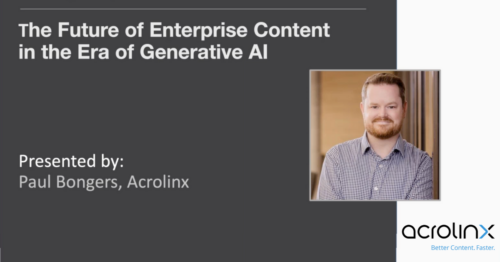

 Paul Bongers is a strategist, technologist, and a SaaS generalist. In his role as VP Strategy, Paul shapes the Acrolinx product strategy. His team works closely with all departments across the business to foster innovation and expand value for Acrolinx customers.
LinkedIn:
Paul Bongers is a strategist, technologist, and a SaaS generalist. In his role as VP Strategy, Paul shapes the Acrolinx product strategy. His team works closely with all departments across the business to foster innovation and expand value for Acrolinx customers.
LinkedIn: 

 Fabrice Lacroix is a serial entrepreneur and a technology pioneer. He has been working for 25 years on the development of innovative solutions around search technology, content enrichment and AI. He is the founder of Fluid Topics, the leading Content Delivery Platform that reinvents how users search, read and interact with technical documentation.

 Alex Masycheff is the CEO of Intuillion Ltd. (

 Amber Swope is an internationally recognized Information Architect, Darwin Information Typing Architecture (DITA) expert, and information architecture (IA) consultant. With over 20 years of information development experience and 15 years of DITA expertise, Amber specializes in helping organizations create opportunity through IA. She helps teams build scalable IA solutions to future-enable their content and empowers team members to advance their architecture as it evolves to meet new business needs.


 Dawn Stevens, President, Comtech Services and Director of CIDM has 28 years of practical experience in virtually every role within a documentation and training department, including project management, instructional design, writing, editing, and multimedia programming. Dawn is the perfect advisor to identify and remove the challenges you face in producing usable, technical information and training content. With both engineering and technical communication degrees, Dawn combines her solid technical foundation with strong writing and design skills to lead our team of consultants and specialists in providing the expertise you need.

 Sebastian Göttel is Head of Marketing and Product Management at Quanos Content Solutions GmbH. The computer scientist has been involved with XML editing systems and content delivery since 1998. In the Tekom environment, he worked on version 1.0 of the iiRDS standard.
 Jacob Brennan is a Technical Sales Product Specialist at Stilo. He works with Stilo Migrate customers and aids in converting their legacy content to DITA. Jacob is a recent graduate from the University of Ottawa holding a BASc. in Mechanical Engineering and a BSc. in Computing Technology.

 Stefan Gentz is the Senior Worldwide Evangelist for Technical Communication at Adobe, headquartered in San Jose, California, USA. Stefan’s mission is to inspire enterprises and technical writers around the world and show how to create compelling technical communication content with the Adobe Technical Communication tools. He is also a certified Quality Management Professional (TÜV), ISO 9001 / EN 15038 auditor, ISO 31000 Risk Management expert, and Six Sigma Champion.
As a sought-after keynote speaker and moderator at conferences around the world, he travels around the globe half of the year. Besides that, he has been the European Ambassador for the Globalization and Localization Association (GALA) for many years, a member of the tekom Conference Advisory Board for several years, and a founding member of the tekom
Stefan Gentz is the Senior Worldwide Evangelist for Technical Communication at Adobe, headquartered in San Jose, California, USA. Stefan’s mission is to inspire enterprises and technical writers around the world and show how to create compelling technical communication content with the Adobe Technical Communication tools. He is also a certified Quality Management Professional (TÜV), ISO 9001 / EN 15038 auditor, ISO 31000 Risk Management expert, and Six Sigma Champion.
As a sought-after keynote speaker and moderator at conferences around the world, he travels around the globe half of the year. Besides that, he has been the European Ambassador for the Globalization and Localization Association (GALA) for many years, a member of the tekom Conference Advisory Board for several years, and a founding member of the tekom 

 Klaus Fleischmann studied translation and IT in Vienna, holds an MA in Conference Interpreting from Monterey, California, and a MAS in Technical Communication from Krems, Austria. In 1996, he founded Austria-based Kaleidoscope, a company implementing content, translation, and terminology management processes for internationally active companies. Kaleidoscope develops online collaboration software for enterprise-level terminology workflow, translator query management, in-country review etc., making the translation quality process comprehensible and strategically manageable. In 2007, he became CEO of Austria´s leading LSP, Eurocom Translation Services. Always active in the industry, Klaus got voted into the Gala Board of Directors in 2015 and 2017.

 Rik has worked with component content and document management solutions for over 20 years. He has worked with custom DTDs and Schemas, S1000D, iSpec2200, and DITA, together with various document and content management systems, including Documentum, SharePoint, XDocs, Ixiasoft, easyDITA, Astoria, and Vasont.
His practical experience ranges from high-volume data capture and content creation to dynamic multichannel delivery in various industries, including banking and finance, manufacturing, central government, and education. In addition, Rik has participated in multiple consultancy projects and helped formulate innovative solutions throughout Europe and North America.
Rik is also an advocate of Documentation 4.0, a new concept reflecting the demands on content/documentation that results from moving to Industry 4.0 and ‘smart’ manufacturing.
Rik has worked with component content and document management solutions for over 20 years. He has worked with custom DTDs and Schemas, S1000D, iSpec2200, and DITA, together with various document and content management systems, including Documentum, SharePoint, XDocs, Ixiasoft, easyDITA, Astoria, and Vasont.
His practical experience ranges from high-volume data capture and content creation to dynamic multichannel delivery in various industries, including banking and finance, manufacturing, central government, and education. In addition, Rik has participated in multiple consultancy projects and helped formulate innovative solutions throughout Europe and North America.
Rik is also an advocate of Documentation 4.0, a new concept reflecting the demands on content/documentation that results from moving to Industry 4.0 and ‘smart’ manufacturing.
 Helen joined Stilo as a technical editor. She now works closely with Stilo Migrate customers, helping them to analyze their legacy content and configure appropriate mapping rules. She also provides Migrate customer training and support. Helen has helped Migrate customers to convert millions of pages of content to DITA and custom XML. Helen holds a Bachelor of Arts in English from St. Francis Xavier University in Antigonish, Nova Scotia, and has pursued graduate studies at Queen’s University in Kingston, Ontario. Email:
 CPQ systems are just one of several business systems that can be enhanced with the content stored within your CCMS. Thomas and Rik will drill down into this with real-world examples of multiple deployments, including QAD’s own experience. They will discuss the pros and potential pitfalls of these combined systems and explore the best approach to take to maximize their success.
Presented by:
Thomas Blumer, QAD
CPQ systems are just one of several business systems that can be enhanced with the content stored within your CCMS. Thomas and Rik will drill down into this with real-world examples of multiple deployments, including QAD’s own experience. They will discuss the pros and potential pitfalls of these combined systems and explore the best approach to take to maximize their success.
Presented by:
Thomas Blumer, QAD
 Fabrice Lacroix is a serial entrepreneur and a technology pioneer. He has been working for 25 years on the development of innovative solutions around search technology, content enrichment and AI. He is the founder of Fluid Topics, the leading Content Delivery Platform that reinvents how users search, read and interact with technical documentation.

 Christian Lang, Technical Consultant, has a wide range of experience and interests in the language field, proven by his degree in Japanese studies and translation. He first became involved with terminology management as a freelance translator for the European Patent Office. Since then, it has become one of his hobbies, as has research in the field of NLP on topics such as machine translation, automatic term extraction, and concept maps.
 Saibal Bhattacharjee has been with Adobe for more than 12 years now and is currently working as Director of Product Marketing & Business Strategy in the Digital Advertising, Learning & Publishing business unit.
Saibal is in charge of GTM and Business Strategy for a $140MN+ product portfolio in Adobe – ranging from market-leading cloud-native component content management system (CCMS), advertising & subscription monetization products for connected multiscreen TV platforms, content authoring, and publishing desktop apps, to print & scan solutions that power Office and Commercial printers, etc.
Saibal drives the products’ positioning and messaging, brand strategy and communications, marketing campaigns and demand generation (growth and retention), partner ecosystem and new market development, customer education, business insights, market research, and analyst relations, sales enablement, and field marketing efforts.
LinkedIn:
Saibal Bhattacharjee has been with Adobe for more than 12 years now and is currently working as Director of Product Marketing & Business Strategy in the Digital Advertising, Learning & Publishing business unit.
Saibal is in charge of GTM and Business Strategy for a $140MN+ product portfolio in Adobe – ranging from market-leading cloud-native component content management system (CCMS), advertising & subscription monetization products for connected multiscreen TV platforms, content authoring, and publishing desktop apps, to print & scan solutions that power Office and Commercial printers, etc.
Saibal drives the products’ positioning and messaging, brand strategy and communications, marketing campaigns and demand generation (growth and retention), partner ecosystem and new market development, customer education, business insights, market research, and analyst relations, sales enablement, and field marketing efforts.
LinkedIn: 


 Mark Gross, President, Data Conversion Laboratory, is a recognized authority on XML implementation and document conversion. Mark also serves as Project Executive, with overall responsibility for resource management and planning. Prior to joining DCL in 1981, Mark was with the consulting practice of Arthur Young & Co. Mark has a BS in Engineering from Columbia University and an MBA from New York University. He has also taught at the New York University Graduate School of Business, the New School, and Pace University. He is a frequent speaker on the topic of automated conversions to XML and SGML.
 Chip Gettinger is the VP of Global Solutions Consulting at RWS, he manages a team that works with customers in maximizing global content with RWS. He has experience working with customers to develop global content strategies, business ROI adoption drivers, change management, and technology adoption for component content management systems. He speaks and blogs about customer successes working closely with industry standards, partners, and customers in technology solutions and deployments.

 Christopher Hill, Technical Product and Project Manager at Data Conversion Laboratory –